
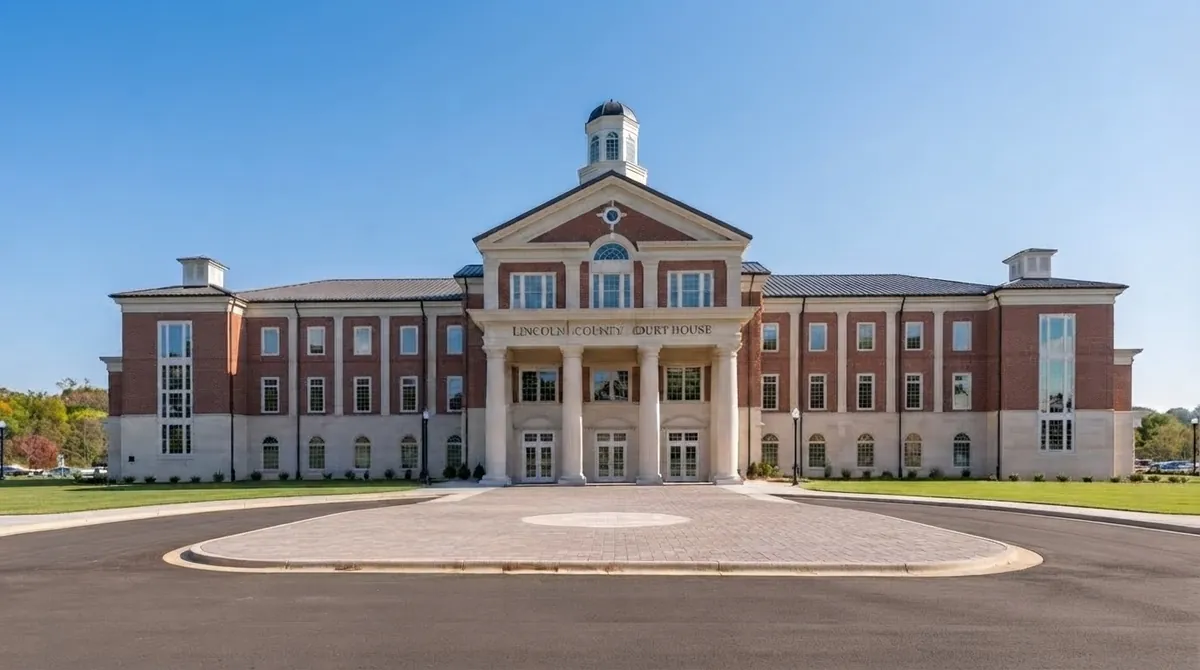
The court records of Lincoln County, North Carolina, are maintained by the office of the Clerk of the Superior Court and are accessible through several channels. LincolnNCCourt.us will help you navigate the publicly available information on court cases in this county. Additionally, records can be found through the eCourts online portal of the North Carolina Judicial Branch, directly at the clerk's office, or through other state government resources.
Lincoln Court System Overview
Lincoln County is part of the 27A Judicial District of North Carolina. This district exclusively serves Lincoln County. The county's court system consists of the District Court and the Superior Court, which operate in the same courthouse in the city of Lincolnton. Magistrates serve as the first line — issuing arrest warrants, setting bail, and hearing small claims. Detailed contact information and court hours can be found on the Lincoln County page on the North Carolina Judicial Branch website.
Lincoln County Courthouse
Courts Serving Lincoln
Residents of Lincoln County are served by several courts of different jurisdictional levels.
State Courts
Lincoln County District Court
Lincoln County Superior Court
Magistrate's Office
Federal Court
Lincoln County falls under the jurisdiction of the U.S. District Court for the Western District of North Carolina, with the nearest division located in Charlotte.
U.S. District Court — Western District of North Carolina (Charlotte Division)
Bankruptcy cases are handled by the U.S. Bankruptcy Court for the Western District of North Carolina at the same address.
What Types of Cases Lincoln Courts Hear
The courts serving Lincoln County hear a wide range of cases. Here are the main categories:
- Criminal cases — felonies, misdemeanors, infractions
- Civil cases — claims of any amount, including small claims
- Family law — divorce, custody, child support, protective orders
- Probate cases — estate administration, guardianship, conservatorship
- Juvenile matters — delinquency, child protection, adoption
- Traffic violations — fines, driving while impaired (DWI)
The Superior Court hears felonies and civil cases with large claims, while the District Court focuses on misdemeanors, family, and juvenile cases.
District Court Cases in Lincoln
In Lincoln County, the District Court is where most people first encounter the justice system. It handles misdemeanors, family law cases, juvenile matters, and civil claims up to $25,000. Felonies initially go through the District Court at the preliminary hearing stage before being transferred to the Superior Court.
The Superior Court takes felony cases after indictment by a grand jury, civil claims over $25,000, and appeals from the District Court. Cases are assigned to judges according to the session schedule. A Superior Court judge is appointed on a rotation basis within the judicial division.
Magistrate Court Cases in Lincoln
Lincoln County magistrates work around the clock and perform essential functions at the initial stage of the court process. They issue arrest and search warrants, set bail conditions, and conduct initial hearings in misdemeanor cases.
In addition to criminal functions, magistrates hear small claims up to $10,000 under North Carolina law. They can also conduct hearings on eviction proceedings and other limited jurisdiction civil disputes. DWI cases start with a magistrate who sets initial release conditions. Traffic violations that do not require a mandatory court appearance are often resolved through the clerk's office without a separate hearing.
Family Law, Probate, and Juvenile Matters in Lincoln
Family Law
Divorce, child custody, child support, paternity establishment, and domestic violence protective orders (DVPO) cases are heard by the District Court. Divorce certificates can be obtained through NC Vital Records or the clerk's office in the county where the divorce was filed.
Probate Matters
The Clerk of Superior Court in Lincoln County acts as a judge in probate matters. This includes probating wills, appointing executors, guardianship of incapacitated individuals and minors, and trust management. Documents must be filed directly with the clerk's office.
Juvenile Matters
Juvenile matters — juvenile delinquency, child protection cases, and adoptions — are heard by the District Court. These records are confidential under North Carolina law. The Guardian ad Litem program operates at the Lincoln County court to represent children's interests in court proceedings.
How Cases Move Through the Lincoln Court System
Regardless of the type of case, the process in Lincoln County courts goes through several stages:
- Case Initiation. A criminal case begins with a complaint or arrest warrant; a civil case with the filing of a complaint with the clerk's office; a family or probate case with the filing of the appropriate petition.
- Assignment of Judge. The case is assigned to a specific judge according to the court session schedule or rotation.
- Initial Hearings. In criminal cases, this is the first appearance of the defendant before the court (arraignment). In civil cases, it's a planning conference.
- Pre-Trial Phase. Parties exchange evidence (discovery), file motions, and negotiate plea deals or settlements.
- Trial or Resolution. The case concludes with a jury verdict, plea agreement, settlement, or default judgment.
- Post-Judgment. Sentencing, filing appeals, or enforcing the court's decision.
You can check the hearing date through the eCourts portal by searching by name or case number.
Court Administration, Local Rules, and Public Access in Lincoln
The administrative judge of the 27A Judicial District provides overall management of the courts in Lincoln County. The court administrator coordinates scheduling, case management, and staffing issues.
Local court rules for this district are published on the North Carolina Judicial Branch website. Before filing documents, it is advisable to review them as they may contain specific requirements regarding formatting, deadlines, and procedures.
Public Access to Records. Under the North Carolina Public Records Act (N.C. Public Records Act, G.S. Chapter 132) and judicial branch rules, most court records are public. Exceptions include juvenile cases, adoption records, sealed records, and some family law materials. Paper files can be viewed directly at the clerk's office in the county where the case is located.
To request a public record from the judicial branch, you can use the online form or contact the office directly. Hearings are usually open to the public. Some proceedings may be conducted remotely — check the possibility of participating via video link with the court clerk's office.
Court Records and Related Court Resources in Lincoln
- Online Case Search. The eCourts Services system allows searching for cases by name, citation number, or case number, as well as making payments and filing documents electronically.
- Court Session Schedule. Hearing dates are available on the Lincoln County page on the judicial branch portal.
- Court Forms and Self-Help Resources. The NC Judicial Branch website provides forms for various types of cases, as well as Guide & File tools for self-filing documents.
- Clerk's Office and Record Requests. To obtain copies of court records, contact the clerk's office or use the public records request form. A fee is charged for certified copies.
- Offender Search in the Correctional System. The Offender Search of the North Carolina Department of Corrections allows finding information about inmates in state prisons, parolees, and probationers.
- Criminal History Check. The NC State Bureau of Investigation is the central repository of state criminal information and conducts background checks.
- Public Records Online. The Public Records page of the Department of Corrections contains links to various databases available without a separate request.
- Tax and Land Records. The Lincoln County GIS Portal provides access to tax maps, land parcel data, and other public records.
- Additional Resources. LincolnNCCourt.us compiles links and instructions for searching Lincoln County court records.